
Thomas Godfrey Baynes, founder of our firm, was instrumental in acquiring Danson Park and its mansion for local people to enjoy in perpetuity.
Danson Park was designed in the 18th century as a private estate and has been attributed to Lancelot Brown (1716 – 1783), more commonly known as 'Capability' Brown, the famous landscape gardener. He designed over 170 parks and is remembered as "the last of the great English eighteenth-century artists to be accorded his due", and "England's greatest gardener".
Danson Park provides a fitting backdrop for the mansion which was built by the wealthy merchant, John Boyd, between 1762 and 1767 and designed by Robert Taylor, the architect of the Bank of England. Its design reflects a fascination with the Golden Age of antiquity and its embellishment contains much symbolism of classical mythology. It is a revival of Italian villa design, prevalent in the area around Vicenza, during the second half of the sixteenth century. The leading architect at that time was Andrea Palladio. 
During the early 1920s, much of the land surrounding Danson Park was eagerly bought up by developers for suburban development. Thomas Godfrey Baynes, the founder of the firm was also Clerk to the Urban District Council of Bexley; a position he held from 1896 until 1934. T G Baynes felt strongly that the historic mansion and park should not only be preserved from the developers but acquired for the use and pleasure of local people. So strong was his belief that the land and mansion should be brought into public ownership that he went ahead and signed a contract for purchase on behalf of the Council without express authority to do so. Luckily, his advocacy skills were such that he retrospectively convinced the Council of the need to acquire the land and house.
After the Second World War, the mansion began to deteriorate through lack of maintenance. An architectural stonemason undertook to carry out repairs in exchange for living in the house and basing his business there, but he stole all the fixtures and fittings, including the valuable fireplaces, and put them in containers ready for export abroad. Fortunately they were recovered before they left the country.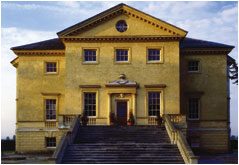
In 1995, English Heritage deemed the site to be ‘the most significant building at risk’ in London. They purchased the site on a long lease in order to carry out the extensive programme of repairs and restoration. Extensive historical and physical investigations were undertaken which demonstrated that it would be possible to restore the house and its Georgian interiors.
In early 2004, with the majority of the restoration complete, English Heritage’s lease of Danson was assigned to Bexley Heritage Trust, who furnished the house ahead of reinstating public access for the first time in over 35 years.
So, its due to English Heritage (and T G Baynes) that this beautifully restored building is still here today for us all to enjoy.
For more information see the Danson House website.

News